
What if Faster Isn’t Always Further
LEADERSHIP IMPACT, AMPLIFIED
September 23, 2026 · Evelina Rog, PhD, PCC
Some leaders have an extraordinary capacity to create momentum. They see what needs to happen, make decisions, mobilize people and get things done. They bring energy into a room. They simplify complexity. They don't get stuck endlessly analyzing possibilities when action is required. Organizations value these leaders for good reason.
I recently worked with an accomplished executive whose leadership assessments painted exactly this picture. She was highly relational and deeply achievement-oriented. Purposeful, energetic, and decisive. Someone who genuinely enjoyed helping others and creating conditions where people could succeed. She could see possibilities and translate them into action.
As we explored the situations in which leadership became more difficult, another pattern emerged. Under pressure, the very qualities that made her effective became amplified and reactive. Decisiveness became impatience, energy became restlessness, a bias for action became acting before the complexity of the situation had been fully understood. Confidence in moving things forward could make it harder to remain with uncertainty long enough to discover what she didn't yet know. And her extraordinary capacity to take things on could lead to taking on too much.
The developmental question that emerged was: How do I preserve the speed and decisiveness that drive results while becoming more strategic about where I focus, what I take on, and what the situation actually requires from me?
When a Strength Becomes a Strategy
This is one of the things I find most fascinating about leadership development. Our derailers are rarely completely separate from our strengths. Often, they are our strengths overused, recruited to protect us from something uncomfortable.
For a highly capable action-oriented leader, doing can feel much better than not knowing. Making the decision can feel better than sitting with ambiguity. Taking responsibility can feel better than waiting for someone else to step forward. Because taking action has worked so well throughout this leader's career, there is plenty of evidence reinforcing the behaviour: "This is how I add value." "People are counting on me." "If I don't move this forward, who will?"
The challenge is that as leadership responsibility grows, the problems change. Executives are increasingly dealing with competing priorities, multiple stakeholders, organizational politics, systemic interdependencies and situations in which there may be no obviously correct answer. The leadership capability required is no longer simply the ability to move. It is the ability to discern – what, when, and how to move.
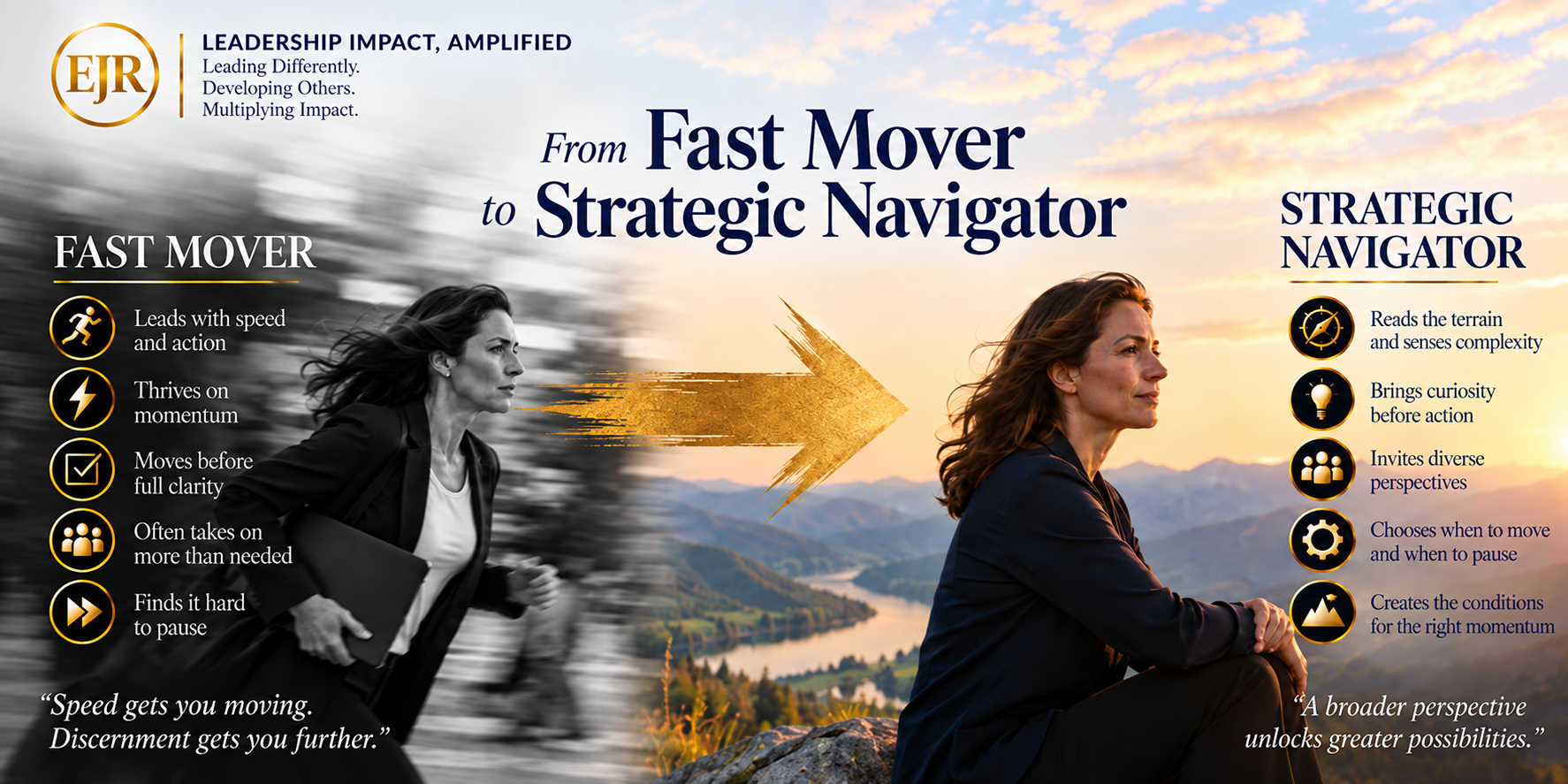
The Shift: From Fast Mover to Strategic Navigator
Strategic leaders still act. They can still be decisive. They can still create tremendous momentum. But they develop another capacity alongside action: the ability to stay curious in complexity so that they can determine what the situation requires. They learn to ask:
What am I not seeing yet?
Whose perspective would change how I understand this?
Is this a situation requiring decisive action, or thoughtful exploration?
What happens if I don't solve this immediately?
Am I stepping in because the organization needs me to, because uncertainty is uncomfortable for me?
That last question can be particularly powerful. Because sometimes what looks like decisiveness from the outside is actually a strategy for managing discomfort on the inside.
This Is Where Coaching Goes Deeper
This is where executive coaching creates a different kind of value. Rather than providing answers or telling an executive what to do, coaching creates the space to examine the pattern beneath the action - what is driving it, what is it protecting, what it is costing, and what other choices might create greater leverage and impact.
But sustainable change requires something deeper. We need to become curious about what makes the old behaviour so compelling in the first place. What does taking action provide? What becomes uncomfortable when you don't immediately know what to do? What assumptions are operating beneath the behaviour? And, what might become possible if you could remain in that discomfort a little longer?
This is also part of what makes this work so difficult. Development at this level often involves as much unlearning and letting go as it does learning something new. Our brains are constantly using past experience to anticipate what will happen next. If you have spent a lifetime being rewarded for moving quickly, solving problems and knowing what to do, that pattern carries a great deal of evidence: this works; this is what I am good at; this is how I create value.
The alternative comes with much less certainty. If I don't step in with the answer, what will happen? Will the conversation go somewhere useful? Will others step up? Will I still be seen as valuable? We don't yet have the same evidence that this new way of leading will work. That gap between the certainty of what has worked and the uncertainty of what might work can keep us attached to the very behaviours we are trying to change.
This is one of the profound shifts that happened for me through my own development as a coach. I learned that my job was not to understand the problem deeply so I could help them solve it. It was to be ok staying in the space where neither one of us had the answer – but in that space, we could uncover the most important question to ask. That is not passivity. It is a different form of leadership. I had to learn to let go of what I was good at since the age of five. It took courage, and practice.
The Pause Is Not the Opposite of Action
For action-oriented leaders, "slow down" can be terrible developmental advice. The goal isn't to become slower. It is to become more choiceful and discerning.
There will be moments when the most effective thing a leader can do is decide quickly, mobilize the team and move. And there will be moments when the most strategic thing they can do is resist the urge to create premature certainty. To ask another question, invite another voice, test an assumption, stay with ambiguity, or allow someone else to find the answer.
The developmental shift is from: I move things forward, to, I create the conditions for the people, priorities and decisions that matter most to move forward, without needing to drive all of it myself.
That is a very different expression of leadership. The executive I was coaching didn't have to give up the qualities that made her successful. Her energy, achievement, decisiveness can remain. But now she has more options. Instead of her strengths automatically determining how she reacts under pressure, she gets to choose how - and when - to use them.
That, to me, is what leadership development is ultimately about. Becoming less constrained by the patterns that have defined how we lead in the past, and having more choice about who we want to be in the moments that matter.
A Question to Take With You
Where might your instinct to move quickly be helping you - and where might it be preventing you from seeing a critical risk, dependency or perspective that could materially change the decision?
Developing Leaders Who Multiply Their Impact
EJR helps executives, teams and organizations to lead differently, develop others, and multiply their impact.
As the exclusive Canadian provider of The Academy of Executive Coaching’s Practitioner Diploma in Executive Coaching, we also develop leaders and coaches who want to build deeper coaching capability.