
When Keeping the Peace Gets in the Way of Leadership
LEADERSHIP IMPACT, AMPLIFIED
September 16, 2026 · Evelina Rog, PhD, PCC
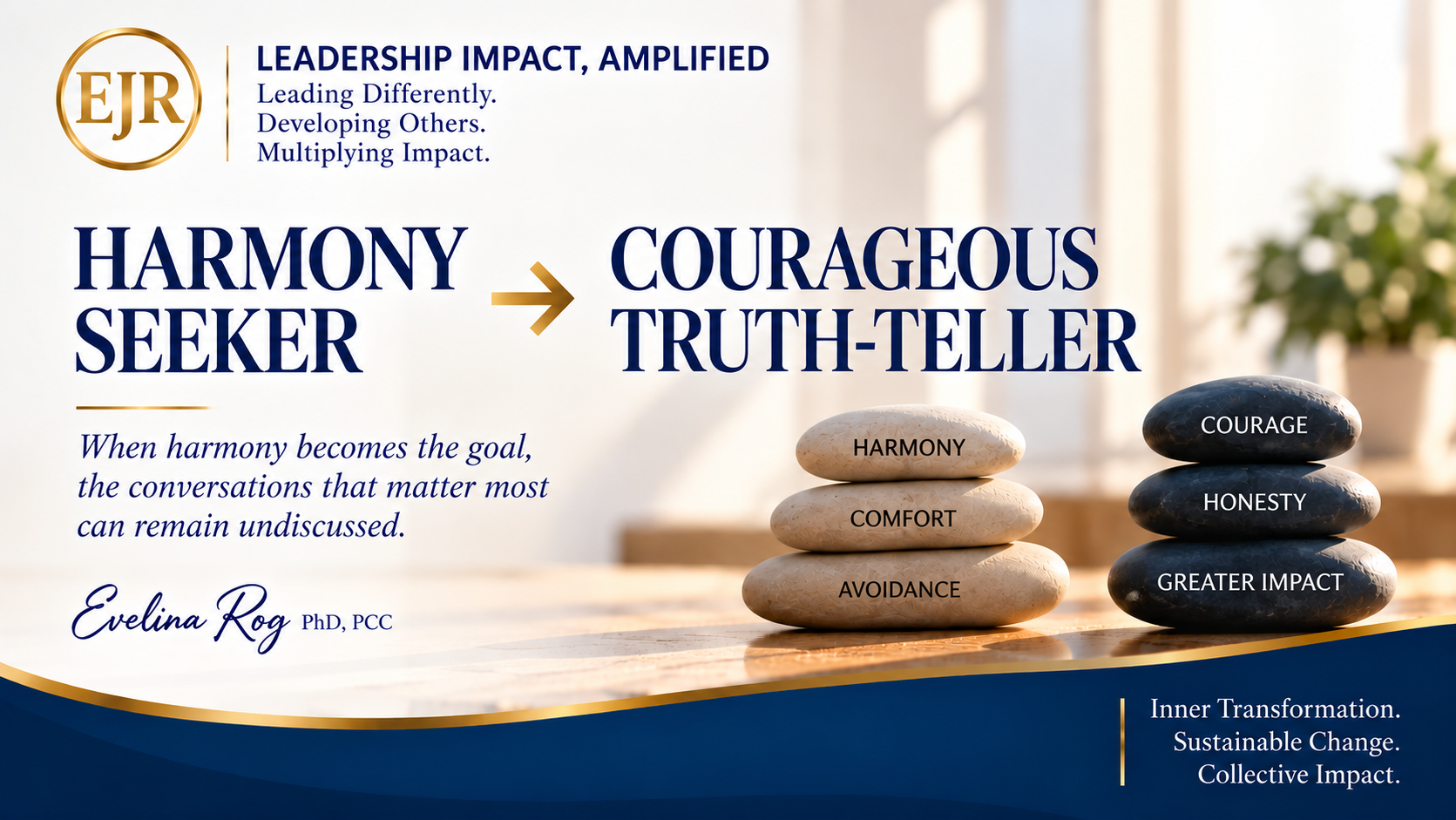
Some leaders walk into conflict with presence, care, and courage. Others instinctively try to make it go away. They lower the temperature by finding common ground, help people see each other's perspectives, use humour to break the tension, and look for a path everyone can live with. These can be extraordinary leadership strengths, until keeping the peace becomes more important than surfacing what needs to be said.
Having taught conflict and debriefed hundreds of leaders on their emotional and relational patterns in conflict, I've come to realize how few of us ever learned to navigate it well. We don't learn it at home, at school, or at work. That included me, until about ten years ago. And yet, it’s the undiscussable conversations executive leadership teams don't have that create the greatest risk.
I recently coached a senior executive who was known as empathetic, collaborative, deeply trusted. But there was a paradox in his leadership. When conflict intensified, especially with strong personalities or authority, his instinct was to go quiet: agree with the loudest voice, use humour to defuse the tension quickly, or work hard after the meeting to solve things behind the scenes. Through coaching, he learned to use those same strengths to be courageous in conflict, not avoid it. This pattern is common among genuinely capable, relational leaders.
When a Strength Becomes a Shield
Many of our most persistent patterns began as strengths - reading the room, keeping people connected. At some point though, those same capabilities that helped us succeed can quietly become a shield. For the executive I coached, the ability to de-escalate had become a superpower. But moving too quickly to break the ice meant the tension temporarily disappeared, but the underlying issue didn't. As he put it: "I learned to calm conflict, mediate and help people move on, but sometimes I move too quickly just to keep the peace."
Reducing tension is not the same as resolving it. Psychological safety is not the absence of discomfort. A team can be highly collegial and still leave its most important issues undiscussed.
The Undiscussables Come with a Cost
Every executive team has undiscussables: the decision everyone privately questions but nobody challenges, the tension between two executives the rest of the team works around, the assumption that goes unquestioned only to burn up months of work, the concern people raise after the meeting instead of during it. Eventually there’s a cost: weaker decisions, fuzzy accountability, resentment, and enormous energy spent navigating around issues instead of through them.
Sometimes the most relational leaders are the most vulnerable to this pattern. Not because they lack courage, but because they care deeply about relationships.
What Courage Is Protecting Against
So why does a capable, trusted leader stay quiet? Rarely because they lack insight. Usually because staying quiet feels like protection. The worries I hear are often specific: that speaking up will make you seem difficult to work with, or that disagreeing without a ready answer will cost you influence. Often, these thoughts are unconscious, operating on autopilot as reflexes: Don't make this harder. You don't know enough about this. This isn't your lane. If you're going to challenge it, you'd better have the answer.
A highly capable leader can look collaborative on the outside while their invisible protective system is making the real decisions on the inside. That’s why I’m so drawn to building leaders’ own coaching capability: the work starts with getting curious about the pattern beneath their own behaviour, not just trying harder to change it, and learning to stay present in the discomfort itself.
Courage Isn't the Absence of Fear
The executive I was coaching set a goal to have courageous conversations sooner, surface issues others were reluctant to discuss, and challenge peers and people with greater authority when it mattered. It wasn’t about being louder or less relational. He needed to learn to stay present when discomfort rose. Instead of trying to make it go away, he learned to notice the fear, the physical activation, the urge to smooth things over or escape, then ask: What does this moment require of me as a leader? That pause opens up different choices.
The deeper shift for him was learning to become curious about difficult emotions instead of suppressing them. In one situation, he noticed his anger, cooled down, and asked what he actually wanted. He connected the emotion to what mattered at an enterprise level and turned it into a clear message and a specific ask. That's emotional intelligence at its most useful: not controlling emotion, but learning from it without letting it drive the car. Emotions become sources of data, not directives, as Susan David likes to say.
Test the Story, Not Just the Behaviour
Then came the part of his development I find particularly powerful. Instead of simply telling himself to "be more courageous," he began running small experiments. He found daily opportunities to speak up about issues outside his immediate accountability, challenged how an important decision was being made, asked to participate in conversations where he believed he could add value, and invited colleagues to observe him and give him feedback.
For most leaders who are willing to try this, the data surprises them. Relational leaders often find that their relationships not only survive courageously authentic conversations, they often become stronger. The executive I coached put it simply after months of testing: "My assumption that people wouldn't value my voice was completely false." That's where transformational development becomes real - not through willpower, but through enough lived evidence that the old story no longer runs on auto-pilot.
Courageous Authenticity Is Not Combat
There's a trap in hearing "be more courageous" as be tougher, or stop worrying about people's feelings. That's not it. Courageous authenticity holds two things at once: I care about this relationship, and I care enough about our shared purpose to say what needs to be said - honestly, in a way that moves people forward. The goal isn't to win the conflict - it's to bring forward what the system needs to hear. It can sound as simple as:
· "There's something I think we're not talking about."
· "I'm noticing we're moving quickly toward agreement - what might we be missing?"
· "I don't have the solution yet, but I'm not convinced we've defined the problem."
· "What are we reluctant to say right now?"
None of that is aggressive. It's a leader choosing to be present, and to show up with clarity, courage, and care.
The Executive Leader's Job Changes
This matters even more as leaders move into enterprise roles. Earlier in our careers, value often comes from expertise. We know our function and speak up when it’s in our lane. At the executive level, that definition becomes too narrow.
Our responsibility is no longer simply to represent our function - it’s to help the organization see itself more clearly by noticing patterns, questioning assumptions, naming tensions, and asking the question nobody else is asking. Sometimes that means saying something important before you know exactly what will happen next - especially when others are likely to react negatively.
For the leader I coached, this was part of a larger shift toward enterprise leadership. His colleagues were already asking him to bring more of his perspective beyond his own portfolio. He didn't need permission to contribute; he needed to trust the value of his voice.
From Harmony-Seeking to Courageous Authenticity
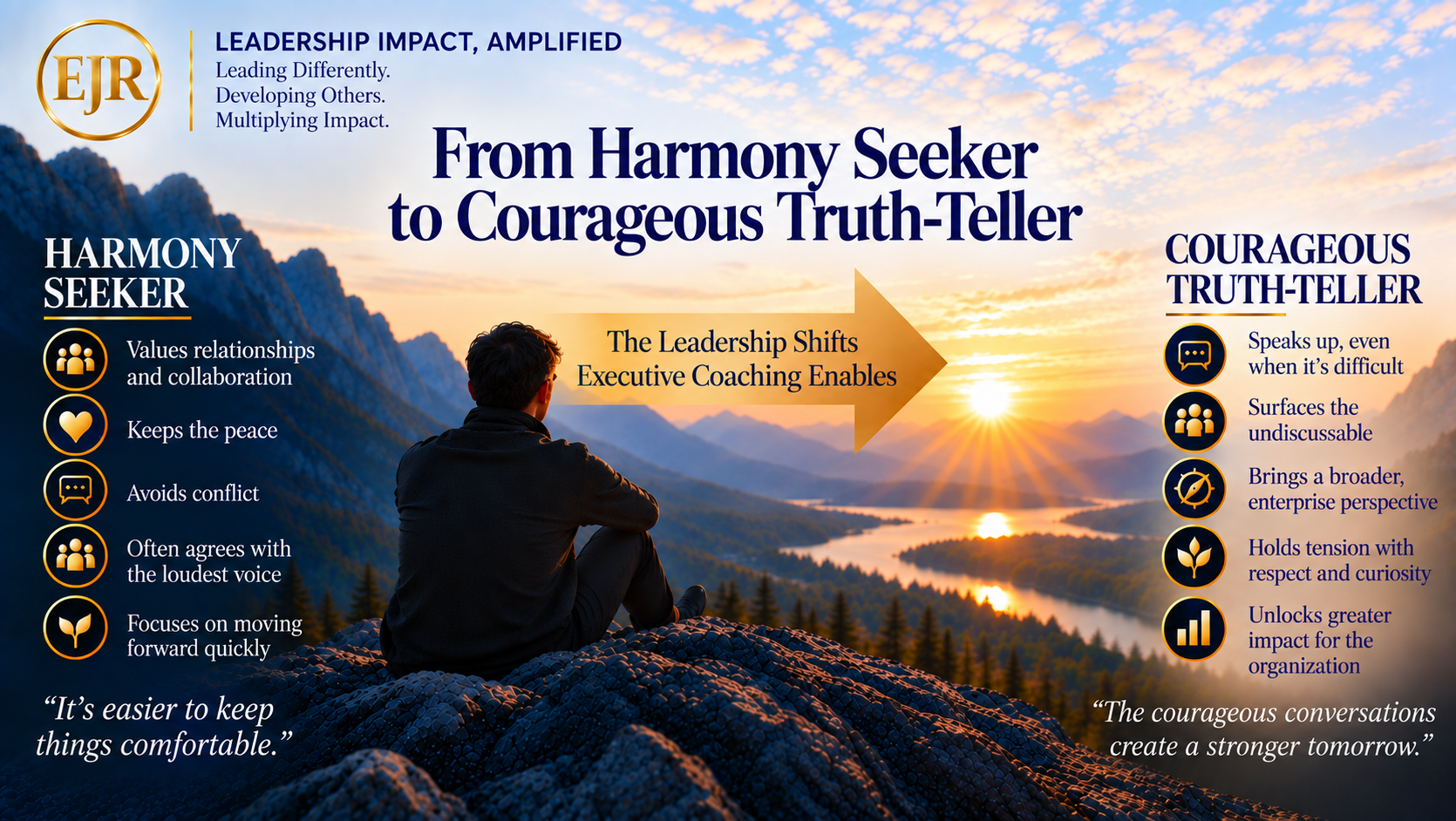
By now, the shift should be clear: it’s not about moving from relational to confrontational. It’s about moving from harmony at all costs to relationships strong enough for truth, from smoothing tension to staying in productive tension, from having the answer to asking the question that needs asking, from protecting credibility to risking some vulnerability, and from speaking only from expertise to speaking for the enterprise. The leader doesn't lose empathy; they add courage to it.
A Question to Take With You
Think about the leadership team you're part of or leading. What are you helping the group avoid talking about, because surfacing it might create discomfort? One level deeper: what are you protecting by staying quiet - credibility, belonging, the comfort of having an answer before you speak? Now consider the other side: what might your team or organization be paying for that silence?
How might you deploy your relational superpowers in service of something bigger?
Developing Leaders Who Multiply Their Impact
EJR helps executives, teams and organizations to lead differently, develop others, and multiply their impact.
As the exclusive Canadian provider of The Academy of Executive Coaching’s Practitioner Diploma in Executive Coaching, we also develop leaders and coaches who want to build deeper coaching capability.