
When Being the Problem Solver Becomes the Problem
LEADERSHIP IMPACT, AMPLIFIED
September 9, 2026 · Evelina Rog, PhD, PCC

I’ve been noticing a pattern lately in my coaching work, including with some very senior and accomplished executives. They know they need to delegate more. They know they should spend less time in the weeds and more time thinking strategically. They know they need to develop the leaders around them rather than being the person everyone turns to with the hardest problems.
Knowing this doesn’t necessarily make it easier to do. I don’t think that’s because these leaders lack delegation skills. More often, I think something deeper is going on. We’re asking people to let go of a way of working, and often a way of understanding their own value, that has helped make them successful. But as leaders move up, being the problem solver is not scalable.
The Paradox of Executive Success
Think about what gets rewarded as people progress through their careers. We notice the person who can figure things out. The one who sees the problem others have missed, steps into something messy, works harder when necessary and can be counted on to get it across the finish line.
If you are bright, conscientious and ambitious, you can become very good at this. People bring you increasingly difficult problems because you have demonstrated that you can solve them. Eventually, you may find yourself leading a function, an organization or an executive team in part because you have spent years being exceptionally good at getting things done.
Then you get feedback that says you need to stop doing so much of it. No wonder this transition is difficult. There can be something deeply satisfying about being the person with the answer. It reinforces competence. It creates an immediate sense of contribution. And when you can see the solution in five minutes, sitting back while someone else takes 45 minutes to work their way toward it can feel terribly inefficient, especially if you know the quality will not meet your standards.
So you help. You offer the answer. You improve their thinking. You rewrite the deck. You join the meeting. You take the problem back. The work gets done, often very well. But what happens to the person whose problem you just solved?
The real shift isn't delegation. It's building something on top of the identity you worked so hard to earn.
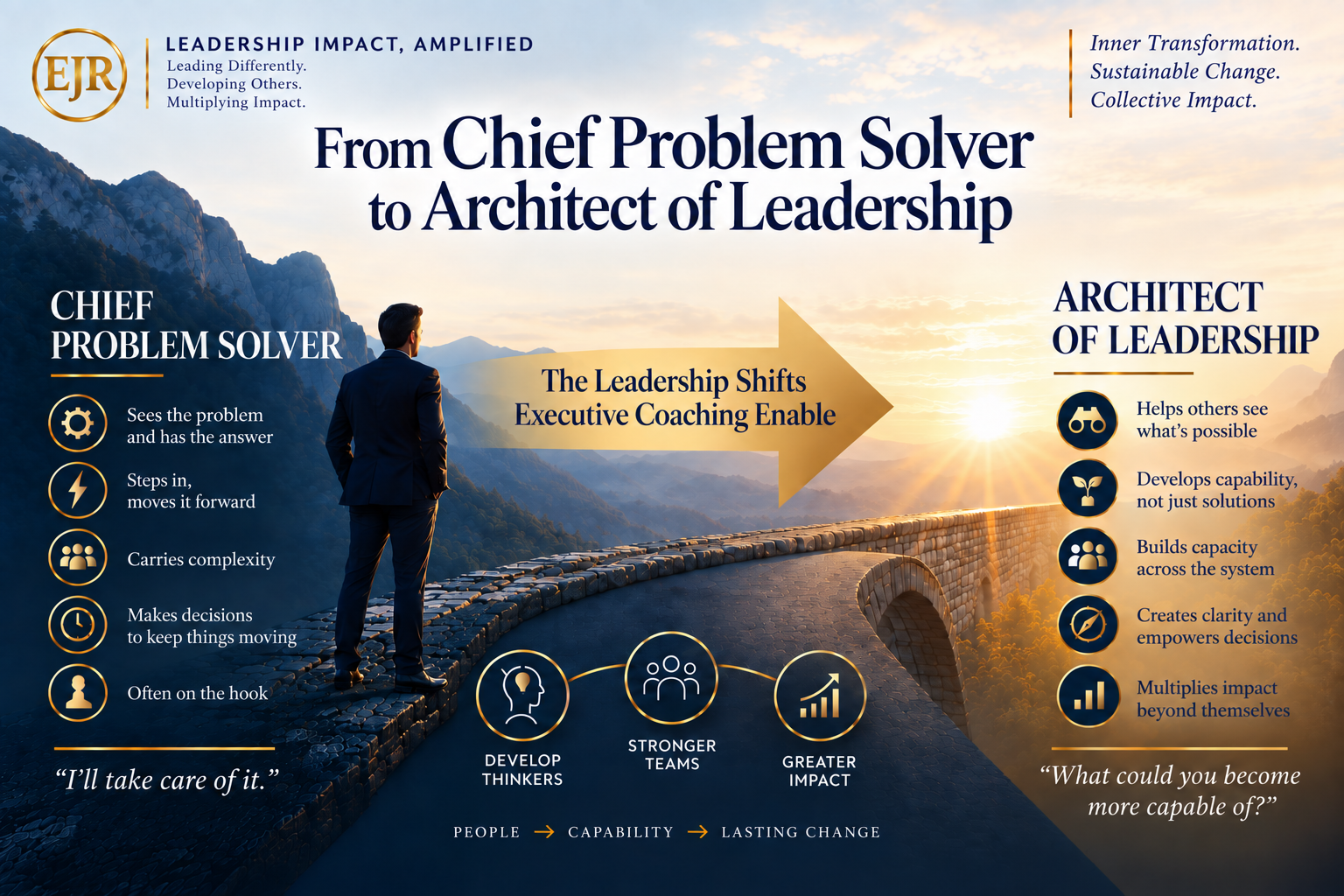
I recently worked with a senior executive whose development goal captured this shift: From Chief Problem Solver To Architect of Leadership. In the middle of a team coaching session, he was humble enough to say to his team “Stop me if you think I’m taking over. I’m part of the problem here.” What I loved about his goal wasn't simply the commitment to delegate more. Underneath it was a much more significant shift in how he understood his contribution as a leader: From believing “my value comes from solving the most important problems, to believing my greatest impact comes from building leaders who can solve them.” That changes everything.
The behavioural commitments that followed were relatively straightforward: spend less time working problems and more time coaching thinking; expect people to bring recommendations rather than only issues; delegate ownership while maintaining accountability.
The real evidence of progress wasn't whether his calendar became less busy. It was whether the leadership system around him became stronger. Were executives making more decisions without him? Were they bringing better recommendations? Were they taking greater ownership? And was he increasingly able to spend his time on the work only he could do - strategy, culture, customers, and the future of the organization? That is a very different definition of leadership effectiveness.
We Can Unintentionally Train People To Be Too Dependent On Us
There is also an uncomfortable paradox here. The more capable you are at solving other people's problems, the easier it is to create dependency without intending to. Someone brings you a problem. You see something they haven't considered, ask a few questions and then offer a solution. They leave with a better answer. Everyone feels as though the conversation was productive.
But the next time they encounter something difficult, what have they learned? Perhaps they have learned something from you. But perhaps they have also learned that when the stakes are high, the safest thing to do is bring the problem to you. Repeat that pattern across a leadership team and the executive team leader can become a bottleneck while simultaneously wondering why people aren't demonstrating enough ownership.
This is why I think the question “What should I delegate?” only gets us so far. A deeper thought-provoking question is: “What am I doing that makes it harder for the people around me to grow?”
From Having the Answer to Developing the Thinker
This is where coaching becomes so important, and why I resist describing it simply as another tool in a leader’s toolkit. Yes, coaching involves skills - listening differently, asking better questions, surfacing assumptions, challenging and supporting. But underneath those skills is a fundamentally different stance toward the other person.
When I am fixing, my attention is primarily on the problem and how to solve it. When I am coaching, I am also paying attention to the person and asking: What could they become more capable of through this conversation?
That doesn’t mean leaders should stop giving advice or sharing expertise. Sometimes the most useful thing a leader can do is provide clarity, make the decision or offer a point of view. Coaching everything would be exhausting - and, frankly, irritating. The developmental work is learning to notice our reflex to step in and becoming more intentional about when we do. Do they need my answer, or am I giving it because I have one? Am I stepping in because the risk requires it, or because watching someone struggle makes me uncomfortable? Does this need my expertise, or is this an opportunity to develop theirs? And perhaps most importantly:
Am I solving today’s problem, or building someone’s capacity to solve tomorrow’s?
There is a well-known idea in psychology that between what happens to us and how we respond, there is a space in which we can choose. I return to this often with leaders because so much of leadership development is about increasing that space. It is in that space that we can notice the impulse to fix, rescue, advise or take over, and choose our response based not only on what will solve the immediate problem, but on the impact we want to have.
Becoming an Architect of Leadership
As our leadership scope grows, I think our definition of contribution has to grow with it. Earlier in our careers, our value may come substantially from what we personally know and do. At more senior levels, our impact increasingly comes from what we make possible through other people and through the systems we create around them.
We still need expertise and judgment. We still need to step in sometimes. But we also need to create clarity without controlling, maintain accountability without taking ownership back, allow people to wrestle with difficult things without rescuing them, and give others enough room to discover that they are capable of more than either of us realized.
That is why I see this as developmental work rather than simply a delegation technique. We are loosening our grip on an identity that may have served us extremely well: I am valuable because I can solve this. And experimenting with another: My greatest value may be in helping other people become capable of solving things I never could on my own.
For a successful leader, that can be a surprisingly vulnerable transition. If I am no longer the smartest person in the conversation, the one with the answer, or the person who saves the day, what exactly am I contributing? I introduce a different kind of question.
Instead of “How much can I accomplish?” consider asking yourself: “What becomes possible because of how I lead?”
Why Coaching Has Changed How I Think About Leadership
This is one of the reasons I have become so passionate about coaching, not only as a profession but as a way of being with other people. Learning to coach well has challenged me to notice how quickly we can impose our own thinking, how tempting it is to be useful by having the answer, and how much more another person can sometimes discover when we don't rush to provide it.
I’ve also come to see that many of the shifts I help leaders make are grounded in foundational coaching capabilities: listening before solving, asking rather than assuming, creating space for different perspectives, challenging thinking without taking over, and helping others build their own judgment. These capabilities extend far beyond a coaching conversation. They shape how leaders make decisions, think strategically, work across silos, strengthen teams, and foster greater ownership and accountability.
Learning to coach doesn't just make us better coaches. It can make us fundamentally better leaders.
A Question to Take With You
Where might being the person with the answer be limiting the growth of the people around you?
What could you do differently this week to develop their thinking rather than solve the problem for them?
Developing Leaders Who Multiply Their Impact
EJR helps executives, teams and organizations to lead differently, develop others, and multiply their impact.
As the exclusive Canadian provider of The Academy of Executive Coaching’s Practitioner Diploma in Executive Coaching, we also develop leaders and coaches who want to build deeper coaching capability.